
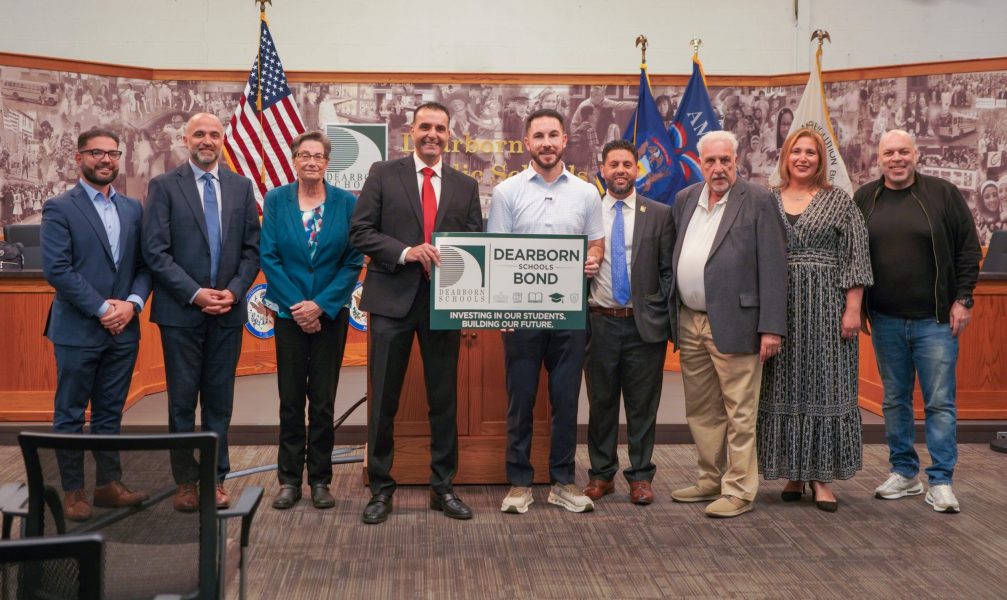
“Tuesday was a historic day for Dearborn Public Schools. But more than that, Tuesday was a statement about who we are as a community and what we believe our children deserve.”
Those words came from Dearborn Public Schools Superintendent Mike Esseily during a press conference on Thursday, Nov. 5, 2026. The event was to discuss and celebrate the passing of the $1.5 billion bond that will transform every building in Dearborn Public Schools over the next 20 years. More than 68 percent of voters approved the bond, with the measure passing in every precinct in the district.
“We are not just building and improving schools. We are building opportunities for generations of children to come, and that was what this bond was about,” Superintendent Esseily said.
The work will include building six new neighborhood schools for students in preschool through eighth grade. Every other building in the district will be fully remodeled, including upgrades like replacing aging boilers, adding or upgrading air conditioning and air filtration, installing new elevators and more. Renovations will include upgrading every classroom, creating STEAM labs, and adding skilled trades exploration in middle schools.
By next summer, work will start to create restrooms that are more private and entryways that are more secure. Critical infrastructure issues such as leaking roofs will also be addressed.
“The foundation of any strong city is the school district, and for families or young people who are entering the workforce, who are trying to identify what city they want to live in, I want you to look towards Dearborn. Dearborn, which is making the largest investment in state history towards public school infrastructure,” said Dearborn Mayor Abdullah Hammoud.
He noted the City of Dearborn worked with the district to ensure the school improvements could be done without increasing the total tax rate for Dearborn homeowners. It may have turned out better that a much smaller bond failed in November 2019 so this bond would be created to truly transform the district, the mayor added.
“As the father of three daughters that are going to enter the public school system fairly soon, I feel like it was only obvious that we went big or went home. And most certainly our residents all voted to go big,” Mayor Hammoud said.
The $1.5 billion is the largest school bond to-date in Michigan. By spreading the work over four phases, the district will be able to finance the bond without raising the total tax rate for Dearborn homeowners. The bond will initially increase taxes by 3.14 mills, but that increase will be offset by two other reductions. The district will waive its 2.18 operating millage on homeowners, and the millage for a City of Dearborn bond for the combined sewer overflow is declining. The total tax rate for the 2026 bond will vary over the years, but any additional increases will be offset by reductions in either the sewer project bond or the tax for a 2013 district bond.
Dearborn Public Schools has 19,500 students in kindergarten through high school and more than 600 in free state preschool programs. The district owns 37 buildings.
Speaking for the Board of Education, Trustee Adel Mozip said, “You have entrusted us with a generational opportunity to modernize our infrastructure and make sure that our schools serve the students the best over the next hundred years.”
Kathi Martin, president of the Dearborn Federation of Teachers, noted how outside of students, teachers will be the ones most impacted by the bond.
“This bond is going to make Dearborn one of the best school districts in Michigan, and I’m so excited to see what happens next,” she said.
First steps outlined
The district also used the press conference to announce the first steps of work related to the bond. For example, a website for community members to track all of the bond work is already under development at www.dearbornschools.org/building-opportunities.
The district is also starting the process to solicit and hire architects to work on designing the three new schools included in phase one. Once architects are hired, the district will gather input on the design, including holding community meetings and soliciting feedback from teachers, administrators, and other staff.
The three new schools slated for the first phase all combine an elementary and middle school and will be built on existing school properties. Those schools include a new building at the Smith Middle School site combining Smith and Nowlin Elementary, which already sit on the same parcel. That building will also include an area for severely disabled students who are currently at Howe School.
Lowrey School, which is already a K-8, will have a new building constructed across the street from the current school. Becker Elementary students also will be moved to the new building.
At the Salina campus, a new Salina Intermediate will be attached to the existing Salina Elementary to create a unified preschool through eighth grade building again.
The first wave of funding from the new bond will not be available until the spring of 2027. Infrastructure work is expected to start in earnest next summer with remodeling of restrooms, creating of secure school vestibules, and other improvements at the first wave of schools across the district.
“We have a tremendous opportunity in front of us and with that opportunity comes a tremendous responsibility,” Superintendent Esseily said. “Our community believed in us. Now it’s time that we deliver for our community. We are ready. We are excited. Let’s get to work.”
Press conference video on YouTube
Superintendent Esseiy’s bond community letter